
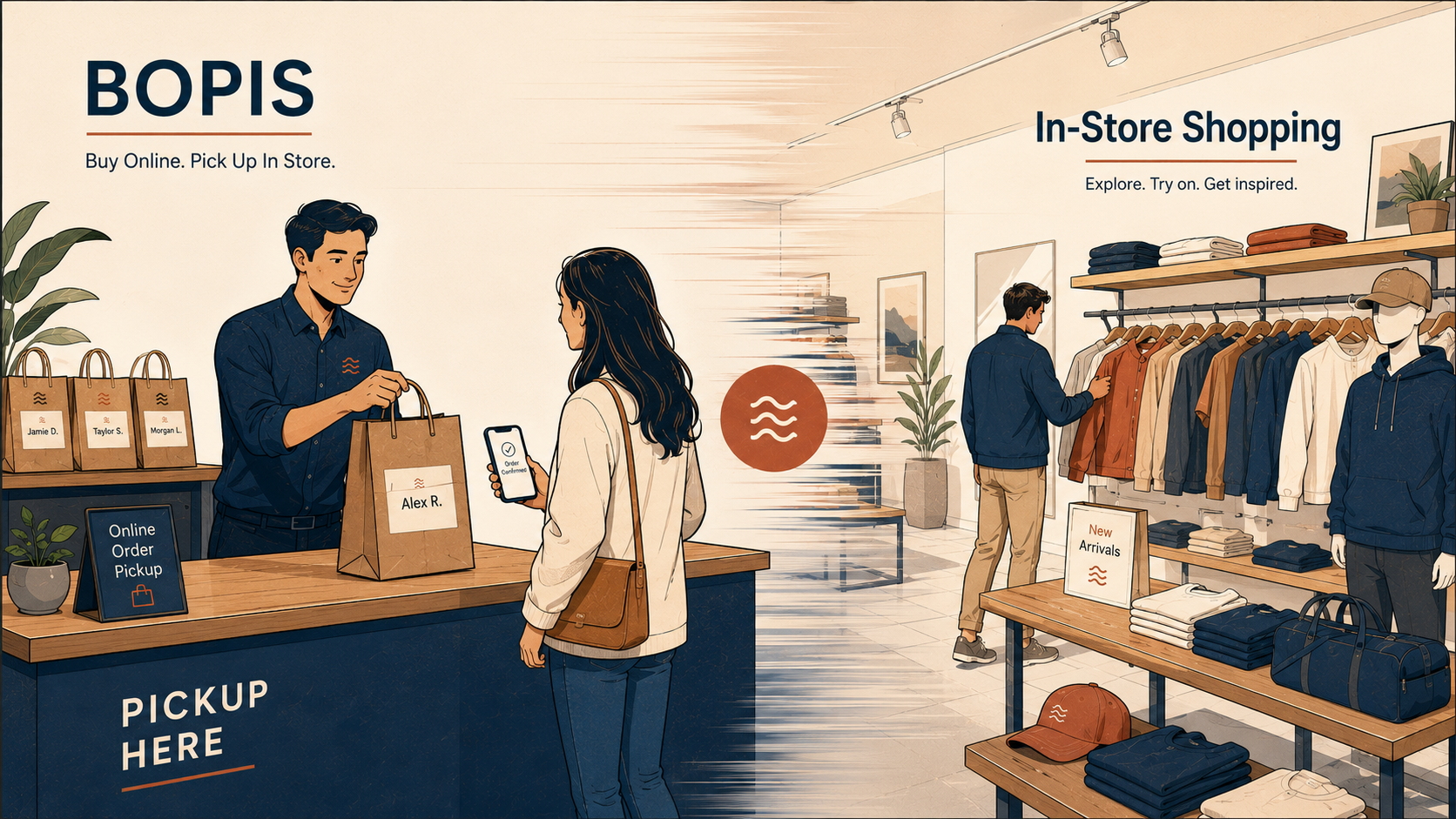
Most brick and mortar retailers think of BOPIS — buy online, pick up in store — as a feature for customers who can't make it to the store. The logic is intuitive: if your customer base lives within fifteen minutes of one of your locations, why would they bother choosing pickup over walking in?
That's the wrong question. Local shoppers choose BOPIS frequently, often when they could just as easily walk in. And the retailers most likely to underinvest in BOPIS are exactly the ones whose customers want it most.
This post is about why local shoppers choose pickup over a walk-in trip, and what brick and mortar retailers tend to get wrong about BOPIS as a result.
The mechanics of BOPIS, briefly
BOPIS means a customer places an order on your website and collects it at one of your stores. The order is reserved, picked, and held until they arrive. The customer takes physical action — the trip to the store — to complete the purchase, just like they would when shopping in-store.
But the BOPIS shopper is focused on their goal (finding that critical item they know they need), not necessarily discovery, like when shopping in-store. Shoppers use BOPIS because their priorities are specific. That's the part that gets missed.
Why local shoppers choose BOPIS over walking in
Several reasons, and they're not what you'd guess.
They want to know, for sure, that the item is in stock. Walking into a store is a gamble. The customer drives over, hunts for the item, and sometimes finds it isn't there — or isn't there in the color, size, or version they wanted. BOPIS removes that uncertainty. The order is placed against confirmed inventory, the item is held with their name on it, and the trip is guaranteed to succeed.
They want the trip to be fast. The online order is a 90-second transaction. The pickup is a 60-second visit. The total customer time is under three minutes. Walking into the store and finding the item, even when the store is laid out well, takes ten to fifteen minutes minimum. For customers who already know what they want, that's twelve extra minutes spent doing nothing useful.
They want to avoid the store experience. Some days the customer doesn't want to talk to anyone, doesn't want to be upsold, doesn't want to hear the latest promotion, doesn't want to park, doesn't want to leave their kids in the car. BOPIS is the version of the visit that strips out everything but the actual transaction. For some customers that's a relief; for others it's the only reason they're buying from you instead of from Amazon.
They want to coordinate around their day. Order at lunch, pick up on the way home. Order from the kitchen on a Sunday morning, pick up after the kids' soccer game. The customer integrates the purchase into a route they're already running. The store visit becomes a stop, not a destination.
They want to comparison shop at home first. Browsing in your store is fine for some customers; for others, it's stressful. They want to compare options, read reviews, weigh price, and decide privately. BOPIS lets them do all of that and then collect with confidence.
They want the item held for them. If a popular size or style is low in stock, the BOPIS customer locks in their unit and walks out with it later. The walk-in customer takes the risk that another shopper buys it first. For inventory that moves, this isn't a small thing.
Notice what's not on this list: distance from the store. None of these reasons require the customer to live far away. All of them apply just as much to someone who lives two blocks from the store as to someone an hour away.
What local retailers get wrong
If your customer base is mostly local, here are the most common mistakes that leave BOPIS revenue on the table.
Treating BOPIS as a distant, third-choice for customers. The pickup option lives buried in the shipping policy page or as a checkbox in the cart. The homepage doesn't mention it. Local-focused email campaigns don't promote it. The customer is left to discover that pickup exists at all — and most of them don't.
Running pickup as an afterthought workflow. The pickup desk is the customer service counter, which is also the returns counter, which is also where the manager handles exceptions. Which may also be the cashwrap. A customer who came in for a 60-second pickup waits behind a customer with a leisurely purchase or a complicated return. The speed advantage that drew them to BOPIS in the first place disappears.
Slow "ready for pickup" notifications. A customer places a pickup order at 2pm, and the ready-for-pickup email doesn't arrive until 6pm — or, worse, never arrives because only some members of the store team check the pickup queue. Customers stop using BOPIS at the store that does this. The cleanest signal of a healthy operation is notifications that fire within an hour of the order, every time, without exception.
Listing items as "available" that aren't actually there. Inventory drift between the POS and the website means a customer orders something, drives over, and finds out the last unit was sold in-store an hour earlier. The technical foundation behind this is real-time inventory sync — every POS transaction reflected on the website within seconds, not minutes. Without it, BOPIS is a coin flip from the customer's perspective. But they only find that out at pickup.
Hiding pickup at the back of the store. Forcing the customer to walk past every aisle to reach the pickup desk defeats the speed advantage that brought them in. It also tells customers the store treats pickup as a back-office function. The pickup area should be near the entrance — it doesn't have to be big but visible and fast.
Under-staffing pickup at peak times. Most stores staff against in-store foot traffic. BOPIS pickup demand doesn't always correlate. Holiday weekends, snow days, lunch hours — these can spike pickup volume even when foot traffic is flat or down. Staff against actual pickup volume, not the proxy.
What good BOPIS looks like for a brick and mortar retailer
A few traits the strong operators share:
The homepage and local marketing promote pickup as a primary option, not a fallback. "Order now, pick up today" appears in the hero or above the fold during peak periods. Email and SMS to local customers actively encourage online ordering with pickup, not just store visits.
Ready-for-pickup notifications fire within an hour, every time. The store team treats the pickup queue as its own operational lane, with its own staffing logic and its own SLA.
The pickup area is near the entrance, clearly signed, and staffed for the speed customers expect. The 60-second pickup actually takes 60 seconds.
Real-time inventory is visible at checkout, so customers can see where the item is in stock before they commit to a pickup location. No surprises when they arrive.
Cross-channel returns work — a customer can pick up at Store A and return at Store B without anyone losing track of the order or the inventory.
Most of these aren't expensive changes. They're decisions about positioning, staffing, and operational priority. The technology underneath has to be solid, but the bigger lift is treating BOPIS as a core customer offering rather than an edge-case fulfillment method.
How Mortar handles BOPIS
For retailers using Lightspeed Retail (R-Series), Lightspeed Retail (X-Series), or Heartland Retail with Shopify, here's how Mortar maps to the mistakes above:
- Inventory accuracy you can promote. Real-time POS-Shopify sync means the website reflects what's actually in stock at each location, within seconds. Customers see honest availability before they commit, so BOPIS isn't a coin flip — which closes the gap on listing items as "available" that aren't actually there.
- Pickup as its own operational lane. Mortar's per-location ShipStation integration routes pickup orders into each store team's existing fulfillment queue — same workflow, same pick lists, same labels they use for shipping. Pickup stops being an afterthought because it shares infrastructure with everything else.
- Per-location order visibility for managers. Order routing puts each pickup order in the right store's queue, so managers can see real pickup volume and staff against it instead of guessing from foot-traffic patterns.
- Returns that span locations. A customer can pick up at Store A and return at Store B. Mortar reconciles the order and inventory across both, so the second store's staff has a transaction to work from and your inventory ledger stays accurate.
- Safety stock thresholds per location. Reserve buffer inventory for in-store demand so BOPIS doesn't deplete your walk-in shelves during high-demand windows.
Two of the mistakes above — hiding pickup at the back of the store, and how customer-facing pickup is positioned in your marketing — are operational and merchandising decisions Mortar doesn't make for you. But the inventory accuracy, fulfillment workflow, returns, and per-location visibility have clean technical answers.
See how Mortar handles BOPIS →
Where to go next
If you're earlier in your BOPIS journey:
- What is BOPIS? A retailer's guide → — the basics of buy online, pick up in store.
- BOPIS implementation guide → — practical setup walkthrough.
If you're already running BOPIS:
- Real-time inventory accuracy: why BOPIS fails without it → — the technical foundation.
- BOPIS for multi-location retailers → — what scales and what breaks at 5+ stores.
See Mortar's BOPIS capabilities →
Add reach without adding overhead. Mortar runs your store and your online store as one operation. Add channels while you keep working in the POS you already use. Sell everywhere your customers are — without the work multiplying. Your store, everywhere. See how Mortar works · Why Mortar